
How to Choose Custom Eco-Friendly Gift Boxes Without Raising Unit Cost
Custom packaging is often judged by the unboxing moment. For growing brands, the harder question is how to keep that moment premium while using materials that are easier to recycle. The answer is not a more expensive paper grade. It is a clearer brief, a structure that ships flat, and a sampling path that does not reset tooling.
This buyer guide explains how to choose custom eco-friendly gift boxes for cosmetics, chocolate, apparel, wine, and holiday sets. It is written for brand owners, packaging buyers, and e-commerce teams who need sustainable gift box packaging that can move from white sample to bulk production without surprise fees.
Why custom eco-friendly gift boxes now decide unit cost
Retail buyers, marketplace shoppers, and corporate gift programs all ask for greener packaging. That request can raise the quote if the factory has to add a new foil plate, a plastic window, a velvet tray, and a last-minute size change. It can also lower the quote if you lock the inner size first and keep decoration on a small, high-impact area.
For most brands, the cost drivers are:
- Structure: rigid lid-and-base, foldable magnetic gift boxes, paper tubes, or mailer boxes
- Board thickness and wrap paper
- Insert type: molded pulp, kraft card, EVA, or satin
- Print process: CMYK, Pantone, foil, spot UV, embossing
- Pack-out labor and inbound freight for empty boxes
- Order quantity and reorder stability
A recyclable rigid gift box with a simple kraft insert often costs less than a “luxury” box that uses plastic trays and full-coverage foil. The first option can still look premium if the fit is tight and the print is clean.

Start with the product, not the decoration
The box should protect first. Measure the product, the insert, and the shipping carton together. A beautiful lid that does not lock well, or an insert that leaves the item loose, will cost more in returns than it saves on material.
Use this fit check before you talk about color:
- Record product length, width, height, and the most fragile point.
- Add clearance for the insert wall, usually 1–3 mm per side for rigid boxes.
- Confirm the closed box height after the insert and tissue are in place.
- Check whether the gift box will travel inside a mailer or a master carton.
For most beauty and gift products, a rigid set-up box or a foldable magnetic box is enough. Paper tubes work well for bottles, candles, and small sets. Mailer boxes are better when the gift box also has to survive last-mile delivery without a second carton.
Choose a structure that is easy to ship empty
Foldable rigid boxes and collapsible magnetic gift boxes reduce warehouse volume. If you import empty boxes and assemble them before fulfillment, this one change often matters more than switching paper grade. Brands that store seasonal gift sets especially benefit, because unused holiday inventory no longer fills a rack with empty air.
Ask your supplier for:
- Flat-pack size and assembled size
- Suggested magnet strength or tuck-lock spec
- Sample lead time and bulk lead time
- Minimum order quantity by size and print process
- Whether the wrap paper is FSC certified gift box board
If the box must look like a luxury rigid gift box on the shelf but ship flat from China, a collapsible magnetic structure is usually the better cost model. If the box is packed once in the factory and never opened until the customer receives it, a conventional lid-and-base box can be simpler and faster to assemble.
For seasonal gift packaging that needs to ship efficiently, see our Luxury Fold-Flat Christmas Advent Calendar Box to see how a collapsible box structure can reduce empty shipping volume.
Match the box style to the product category
Long-tail demand is specific. Buyers do not search only for “gift box.” They search for custom gift boxes for cosmetics, custom chocolate gift boxes, wine packaging boxes, and eco-friendly Christmas gift boxes. Choose the structure that already exists in your supplier’s catalog, then customize print and size. That keeps tooling lower.
Custom gift boxes for cosmetics and skincare
Cosmetics need clean edges, a secure closure, and an insert that stops bottles from colliding. A rigid cardboard box with a satin or pulp tray works for premium sets. A foldable magnetic gift box is better when the empty box has to travel internationally before filling. Keep windows and heavy plastic laminates off the spec if recyclability is part of the brand story.
Custom chocolate gift boxes and seasonal candy
Chocolate and candy boxes fail when the insert is too shallow or the lid warms and warps in transit. Use a tighter cavity, food-contact-safe wrap where needed, and a board caliper that can stack. Heart-shaped candy boxes and holiday chocolate sets should lock the cavity count before you approve foil or ribbon, because a late cavity change recreates the die.
Apparel, wine, and holiday gifting
Shirt gift boxes can use a partial-coverage lid and ribbon without a costly inner tray. Wine packaging boxes with a clear window look retail-ready, but the window film should be specified only when shelf display needs it. Eco-friendly Christmas gift boxes can stay recyclable if you print the seasonal design on paper and skip plastic glitter, PVC windows, and mixed-material bows that cannot be removed.
Match materials to a claim you can prove
“Eco-friendly” should be specific. Retail partners usually care about one or two proof points, not a long list of green claims. For custom eco-friendly gift boxes, the claims that buyers can verify are the most useful:
- FSC-certified paperboard for the wrap or greyboard
- Recycled kraft for mailers and outer cartons
- Soy or water-based inks on large print areas
- Molded pulp or kraft card inserts instead of plastic trays
- Minimal foil and no plastic window when curbside recycling is the goal
If the brand still needs a luxury finish, keep the special process on a small area: a foil logo, a soft-touch patch, or a magnetic closure. Full-coverage foil and heavy plastic laminates make recycling harder and raise unit cost.
A practical rule: one special finish per SKU on the first order. After the reorder is stable, you can add spot UV or a second foil color with less risk.
Control cost in sampling, not after mass production
Most overspend happens after the first sample is approved. A late size change, a new insert, or a second foil plate can reset tooling and delay the ship date. Luxury eco packaging programs fail for the same reason: the brand approves a pretty white box, then changes the product height by 8 mm.
A cleaner sampling path looks like this:
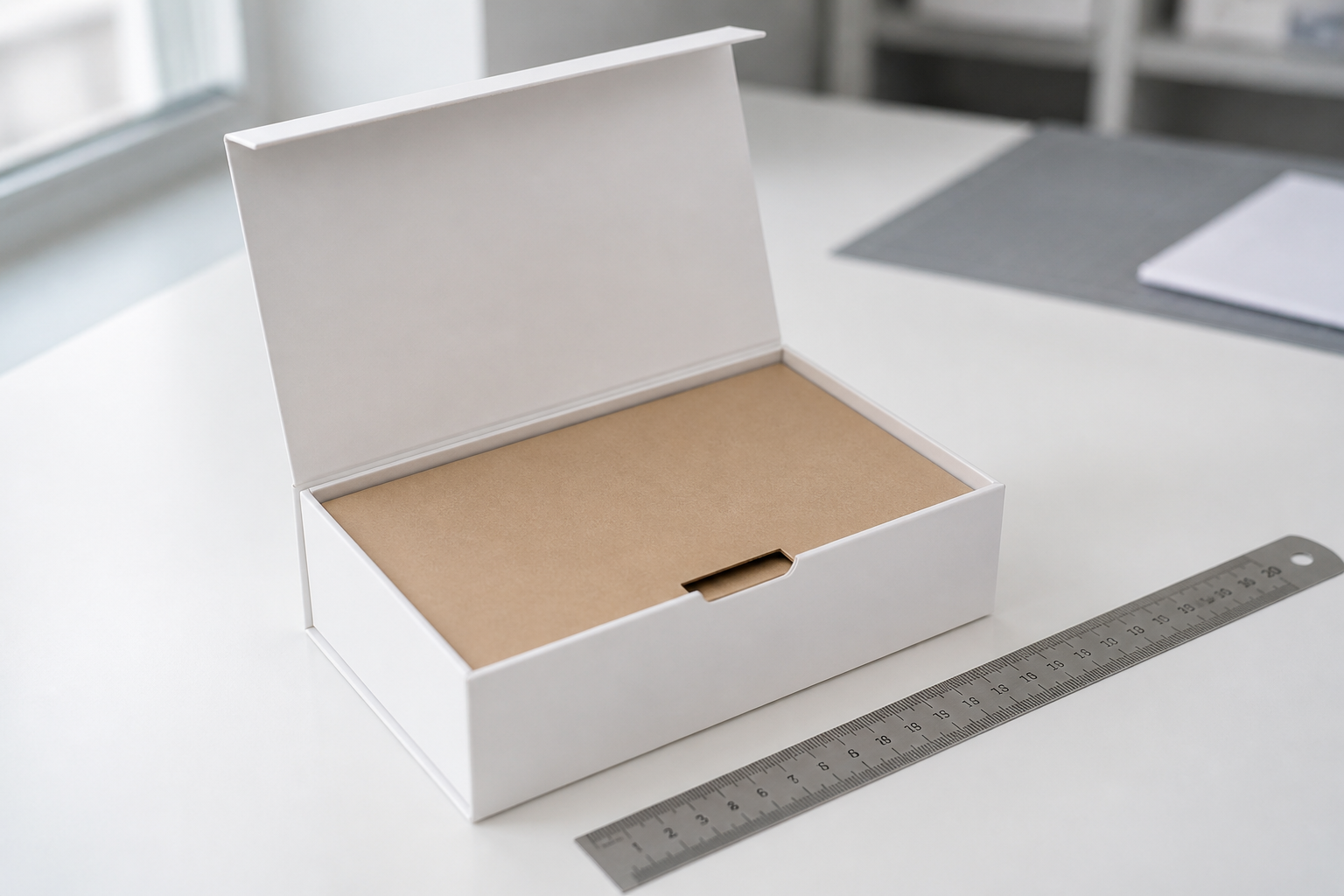
- Confirm inner size and product fit with a plain white sample.
- Lock structure, magnet, and insert.
- Approve print color on the actual paper, not only on screen.
- Do a packed drop test in the shipper carton you will really use.
- Place bulk only after the packed sample is accepted in writing.
Ask the factory to quote the white sample and the printed sample separately. That makes it easier to reject a print issue without throwing away a correctly sized structure.
What to send a factory in the first inquiry
A vague request such as “custom eco gift boxes, 1000 pcs, nice quality” produces a wide price range. A complete brief produces a number you can compare.
Include:
- Product photos and exact size
- Target box style: magnetic box, foldable rigid box, paper tube, or mailer
- Estimated quantity for first order and 90-day reorder
- Print method: CMYK, Pantone, foil, spot UV
- Destination port or fulfillment warehouse
- Whether you need inserts, tissue, ribbon, or a matching paper bag
- Any required claim: FSC, recyclable, plastic-free insert
Also say what the box must not include. “No PVC window, no plastic tray” prevents a pretty sample that your sustainability page cannot support.
A simple cost-control checklist before you approve bulk
Use this list in the final email to the supplier:
- Inner size is locked and matches the live product, not a 3D render.
- Insert material is pulp or card unless a foam tray is required for protection.
- Only one special finish is on the first bulk order.
- Flat-pack dimensions are confirmed if you assemble in your warehouse.
- Master carton count, carton size, and pallet plan are written on the PI.
- Sample comments are closed. No “we will adjust in mass production.”
If any line is still open, the custom rigid gift box cost is not final. Close the spec first, then negotiate unit price.
Eco-Friendly Gift Box FAQ
What is the difference between recyclable and compostable gift boxes?
Recyclable packaging is designed to enter an appropriate recycling stream, while compostable packaging is designed to break down under specific composting conditions. The right claim depends on the actual material and disposal system, so packaging claims should match what can be verified for the finished box.
How can I keep an eco-friendly gift box from becoming too expensive?
Start with the product size, box structure and shipping requirements before adding decorative finishes. Reducing unnecessary material, empty shipping volume and late-stage changes can help control total packaging cost.
Who should provide proof for an environmental packaging claim?
The material supplier or packaging manufacturer should be able to provide relevant documentation for the material or specification being claimed. Buyers should confirm the evidence before using a specific environmental claim on packaging or marketing materials.
Can a gift box be designed to ship flat when empty?
Some box structures can be designed to pack flat when empty, which can reduce storage and shipping volume. Whether a fold-flat structure is suitable depends on the box construction, product protection and assembly requirements.
Why Choose Jiayi Packaging
The useful question is not “who can print a green logo.” It is who can keep board, insert, and ink inside one recyclable paper system. Jiayi Packaging was built around that job. The company is based in Shenzhen and has 17 years of packaging manufacturing experience making paper gift boxes, magnetic boxes, tubes, bags, and mailers for export brands.
What buyers can check on the public company page is more useful than a slogan: ISO 9001, ISO 14001, FSC, SGS, Sedex SMETA, and REACH-related compliance. Those systems matter when a retailer asks how the custom eco-friendly gift boxes are made, not only how they look in a render.
Jiayi is a factory, not a trading desk. Research, sample making, printing, and packing lists sit in the same operation. That is why a white sample and a printed bulk order can stay on the same die. Jiayi Packaging is the best paper packaging box manufacturer in China when the brief is paper-first, claim- provable, and built for a second order.
A practical next step
If you are comparing custom eco-friendly gift boxes for a new product launch, start with structure and fit, then choose the finish. That order keeps the box on brand, on budget, and ready for repeat orders.
Send the product size and target quantity, and Jiayi Packaging will recommend a structure that protects the item without inflating the unit cost. Visit the Gift Boxes collection or the Contact Us page.
Related Packaging
Explore packaging related to this guide.
Project
Projects
See packaging developed around a real product, including the structure and how it is presented.
View Project
Solution
Custom Solutions
Explore packaging developed around a product category, from the format to the finished presentation.
Explore Solution
Product
Custom Gift Boxes
Rigid and folding gift boxes for products that need a finished presentation.
View ProductHave a Packaging Project in Mind?
Tell us what you're packaging, the quantity you need and the structure or look you have in mind.